While most would associate mid-century surrealist Gertrude Abercrombie (1909-1977) with the Chicago art scene, the Milwaukee Art Museum is highlighting the movement’s iteration in Wisconsin—only a stone’s throw north of the Windy City. Gertrude & Friends: The Wisconsin Magic Realists is on view through July 30. (It coincides with the major touring exhibition Gertrude Abercrombie: The Whole World is a Mystery which concludes its run at the Milwaukee Art Museum on July 19).
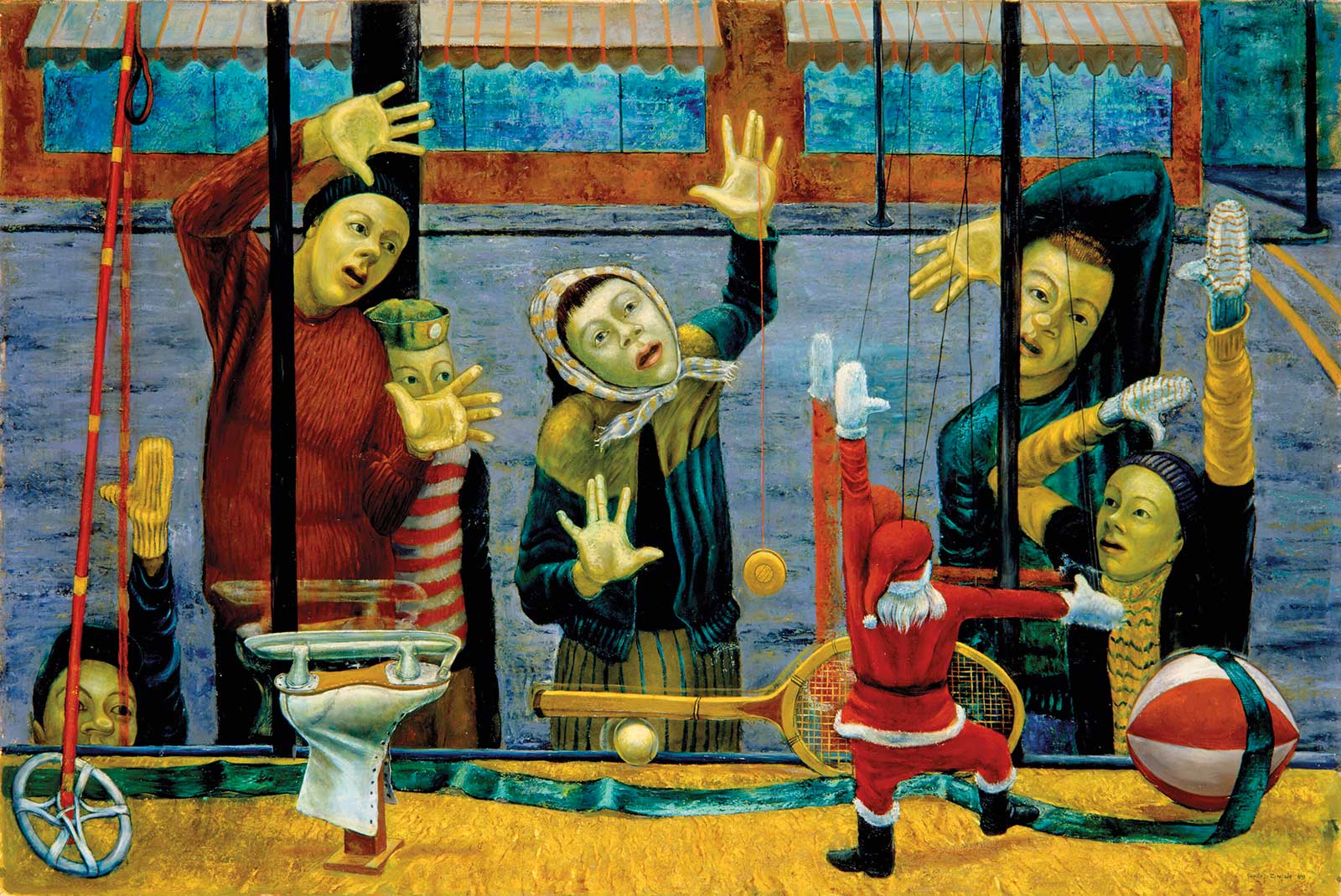
Santos Zingale (1908-1999), Playthings in Show Window, 1949. Oil on Masonite panel, 315⁄8 x 47 in. Milwaukee Art Museum, Gift of Gimbel Bros., Milwaukee, M1959.11. Photo by P. Richard Eells.
The colorful, bohemian troupe of artists that became known as the Wisconsin Magic Realists was led by painters John Wilde and Karl Priebe, a dear friend of Abercrombie’s, and included Aaron Bohrod, John Steuart Curry, Marshall Glasier, Anna Louisa Miller and, unofficially, Santos Zingale.
They spanned the artistic communities of Milwaukee, Madison, and Chicago and, in addition to their creative partnerships, were unified by a love of jazz and bebop that led them to frequent the same clubs in Chicago, where they formed friendships with legends like Dizzy Gillespie. “In a nutshell, there was great awareness on the part of Wisconsin artists about what was happening in the Chicago art world and, I would argue, vice versa,” says curator Thomas Busciglio-Ritter.
The artists were also unified in their fantastical depictions of the Midwest, sometimes unsettling, sometimes playful, often strange, as a means of drawing attention to the oddities of the American experience.
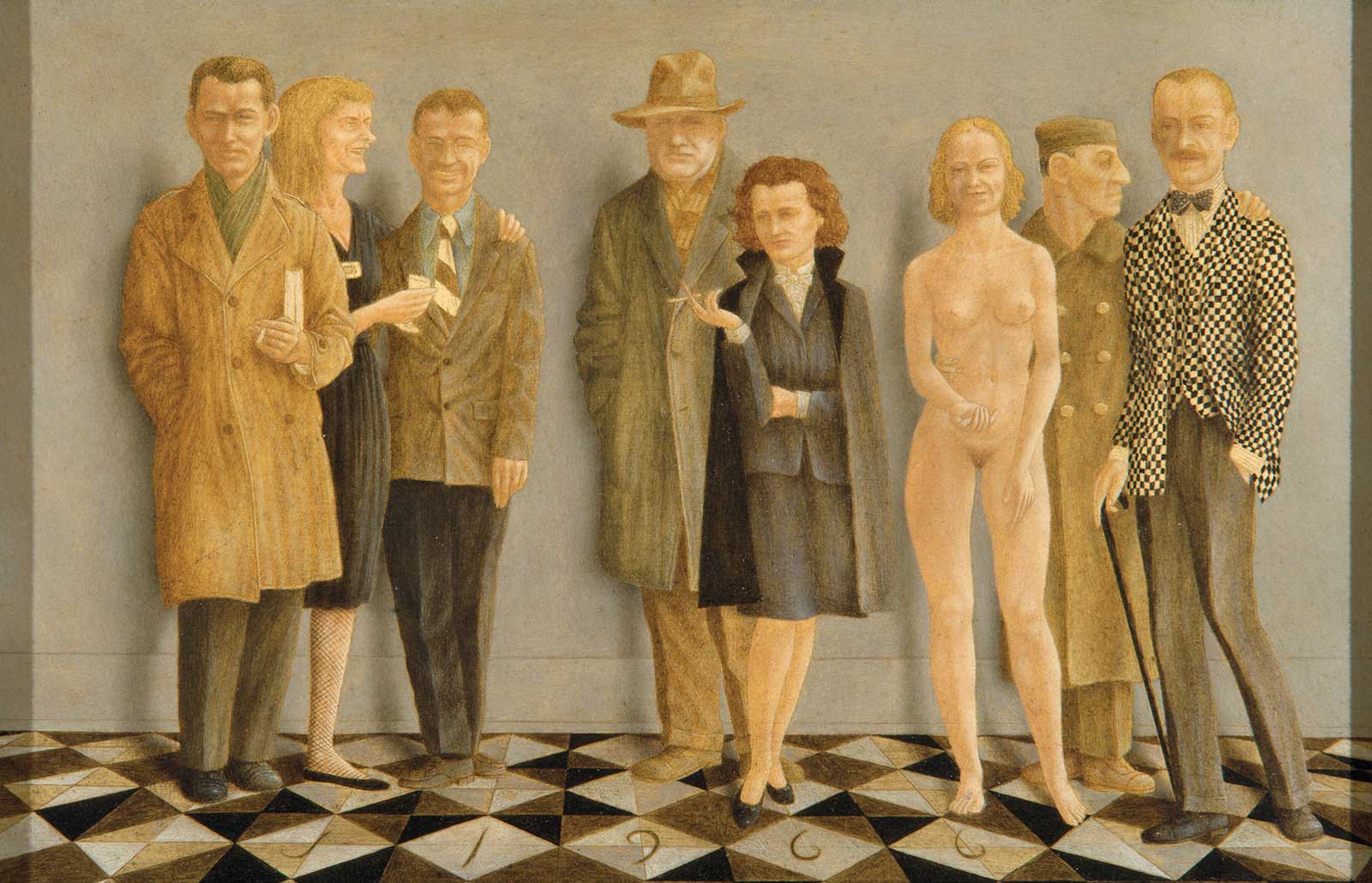
John Wilde (1919–2006), Karl Priebe, Gertrude Abercrombie, Dudley Huppler, Marshall Glasier, Sylvia Fein, a Friend, Arnold Dadian and Myself, 1966. Oil on panel, 8 x 12 in. Milwaukee Art Museum, Gift of the Gertrude Abercrombie Trust, M1979.33. Photo by P. Richard Eells © John Wilde.
In Zingale’s Playthings in Show Window, a group of zombie-like children press their faces against a shop window agog over a display of shiny new toys.
“But by placing the viewer on the side of the objects, Zingale is blurring the line between observer and observed,” says Busciglio-Ritter. “From this viewpoint, it is almost as if the gawking kids become the spectacle or the objects on display.”
John Wilde’s 1966 group portrait depicts key members in the Magic Realist circle a couple decades after they dispersed. “The artist himself stands at the far right, wearing a checkered jacket,” explains Busciglio-Ritter.
“The portrait conveys their signature weirdness or eccentricity, which they embraced. This is also manifest in the presence of an unnamed nude woman, who may just as well be a figment of the group’s imagination or a muse materialized through their collective power of creation.” Busciglio-Ritter notes that the portrait was purchased by Abercrombie from Wilde for her collection. “She was particularly fond of it and sent him a beautiful thank-you letter in which she remarked, “I am not going to hang it; I am going to hold it on my lap all the time.” —
Powered by Froala Editor