When tasked with organizing a permanent collection exhibition for the nation’s 250th anniversary, American regionalism seemed a natural choice to Fort Wayne Museum of Art research curator Sachi Yanari-Rizzo. Not only is the Indiana museum located in the movement’s heartland, it had a strong foundation for the exhibition in works by the “Regionalist Triumvirate”: Thomas Hart Benton, John Steuart Curry and Grant Wood.
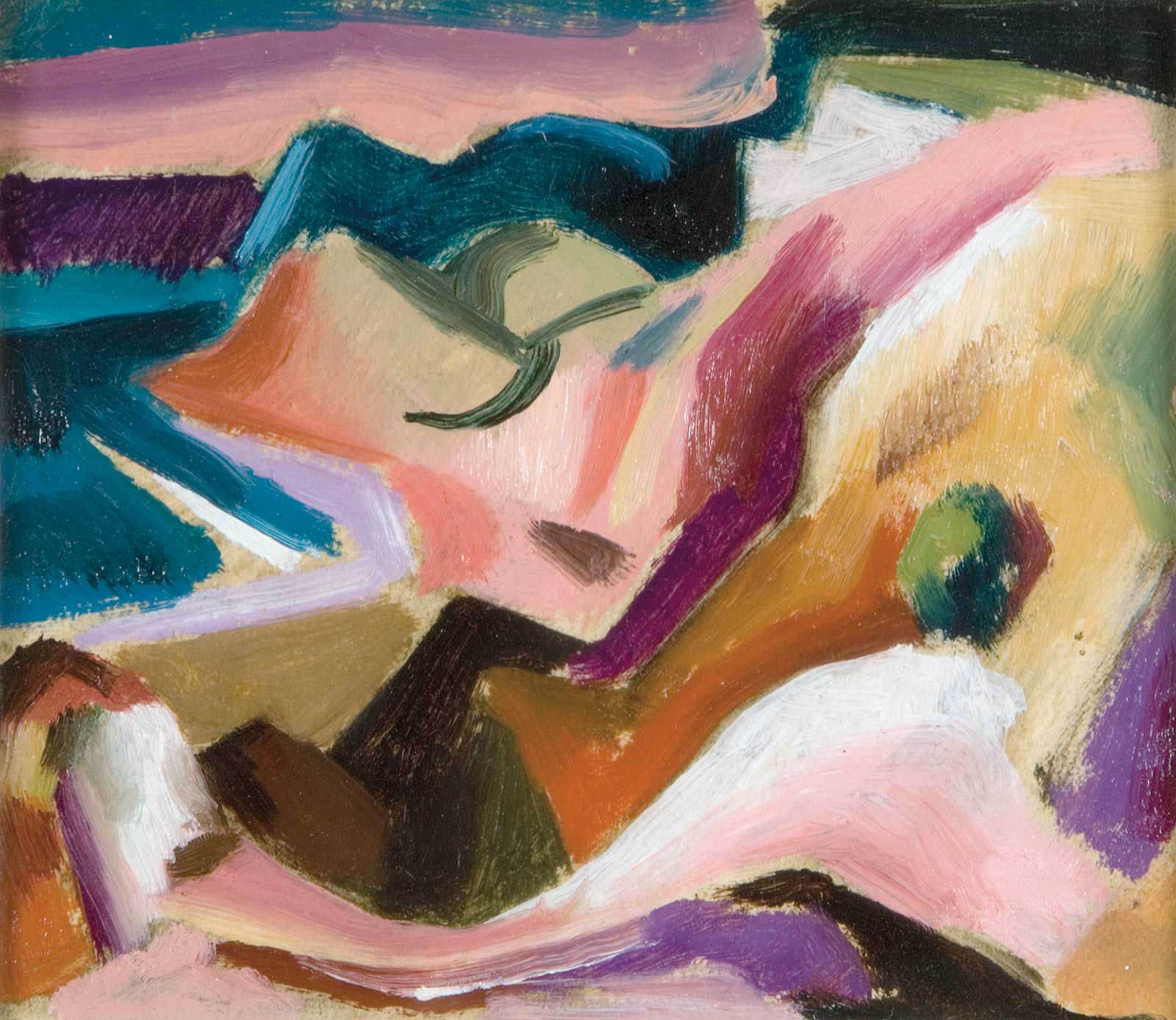
Thomas Hart Benton (1915-1920), Landscape Bay #14. Oil on paper, 6 x 6¾ in. Gift of Patricia Adsit through the Arts United Renaissance Campaign.
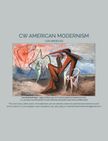
On view May 9 through July 12, American Regionalism and Images of the Heartland features 30 works, with a strong emphasis on prints, that use examples by Benton, Curry and Wood as a springboard to highlight works by their contemporaries, including Margaret Burroughs, Adolf Dehn and Doris Lee, as well as more recent depictions of rural life in America.
“In my initial proposal for the exhibition, I hastily used the term heartland, which later I found to be rich in meaning,” explains Yanari-Rizzo. “Heartland can be a concept. The Merriam-Webster Dictionary suggests it is ‘the central geographical region of the U.S. in which mainstream or traditional values predominate,’ but is this true? The exhibition includes contemporary works as well since middle America is not homogenous but reflects a variety of voices and experiences whether it is seen in the work of Indigenous artist Duane Slick (Mesqwaki and Ho-Chunk), who was born in Iowa, or Don Kruse and Max Altekruse who depict Amish life.”
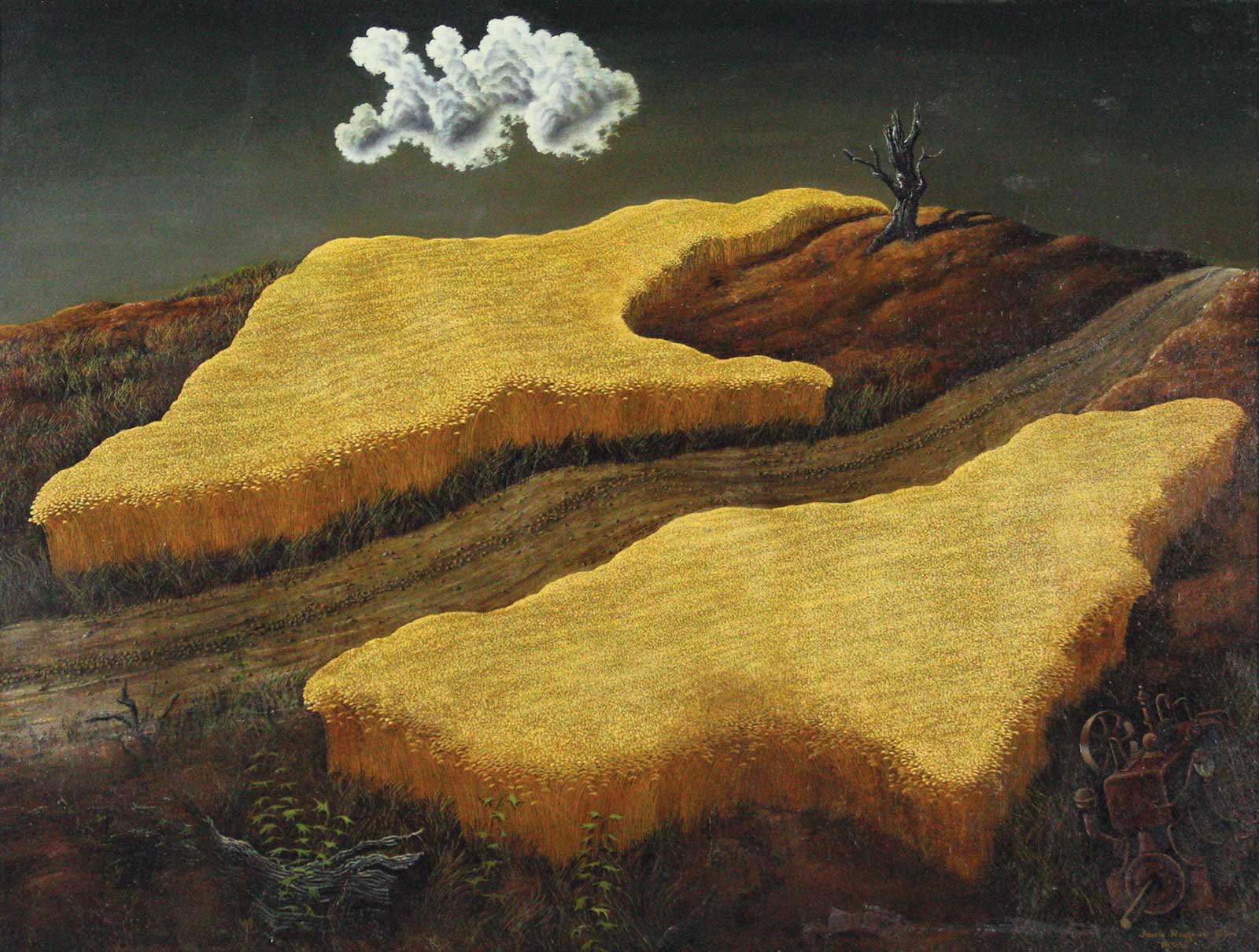
John Rogers Cox (1915-1990), Summer, 1954. Oil on artist’s board, 18 x 24 in. Gift of Joan and Bill McNagny.
Yanari-Rizzo continues, “The Heartland has become synonymous with ideological symbols. John Rogers Cox, Don Nice, and others focused on corn and wheat, Midwestern agricultural mainstays that have become emblematic of the region. Rather than depicting a landscape in his screenprint entitled Heartland, Don Nice isolated iconic American symbols of popular pastimes and food: a football, an ear of sweet corn, baseball cap, and blossoms, possibly apple blossoms as a reference to apple pie.”
Regionalism was a realist art movement of the 1930s and ’40s that largely focused on depictions of rural life and small town America. Unlike much of the broader modernist movement, it rejected European abstraction in favor of nostalgic, nationalistic scenes of everyday life.
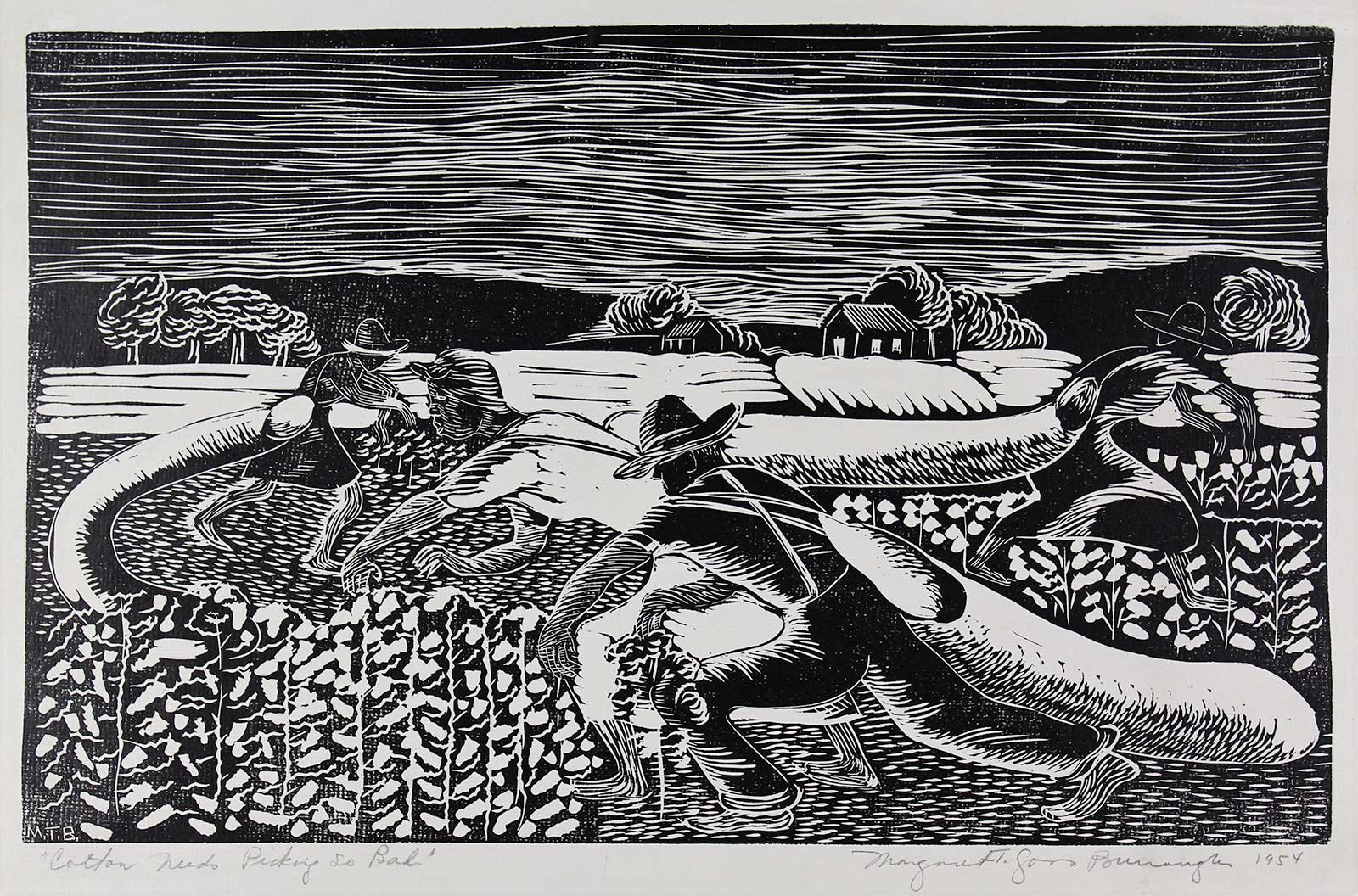
Margaret Taylor Goss Burroughs (1915-2010), Cotton Pickers in Texas, 1954. Linocut on paper, image: 101⁄8 x 16½ in., sheet: 15 /2 x 19 /4 in. Purchase with funds provided by the June E. Enoch Collection Fund.
“In the aftermath of WWI and the stock market crash, leading into the Great Depression, the country developed a policy towards isolationism, and hence a wave of nationalism,” explains Yanari-Rizzo. “I believe that many Americans explored this in a search for a national identity in art. Many of the regionalists distanced themselves from European modernism by turning to subjects that felt American, like the heartland, and using a representational style. They were still aware of what was going on in Europe. For example, Floyd Hopper, Gregory Orloff and Herman Trunk depicted farm scenes through simple, geometric forms, that seem to retain traces of cubism’s influence.”
That influence can be seen in works like Benton’s Landscape Bay #14 from circa 1915-20. Benton had traveled to Paris in 1908 where he was exposed to impressionist works by Paul Cézanne and Paul Signac. He also met Stanton Macdonald-Wright, founder of the modernist subgenre synchromism, typified by a dynamic use of color. “In Landscape Bay #14, Benton explored synchromism by using color to create rhythms, planes and structure,” notes Yanari-Rizzo. “Although [he] experimented with abstraction, the return to his home state Missouri in 1924 inspired him to acknowledge his midwestern heritage and focus on American rural themes.”
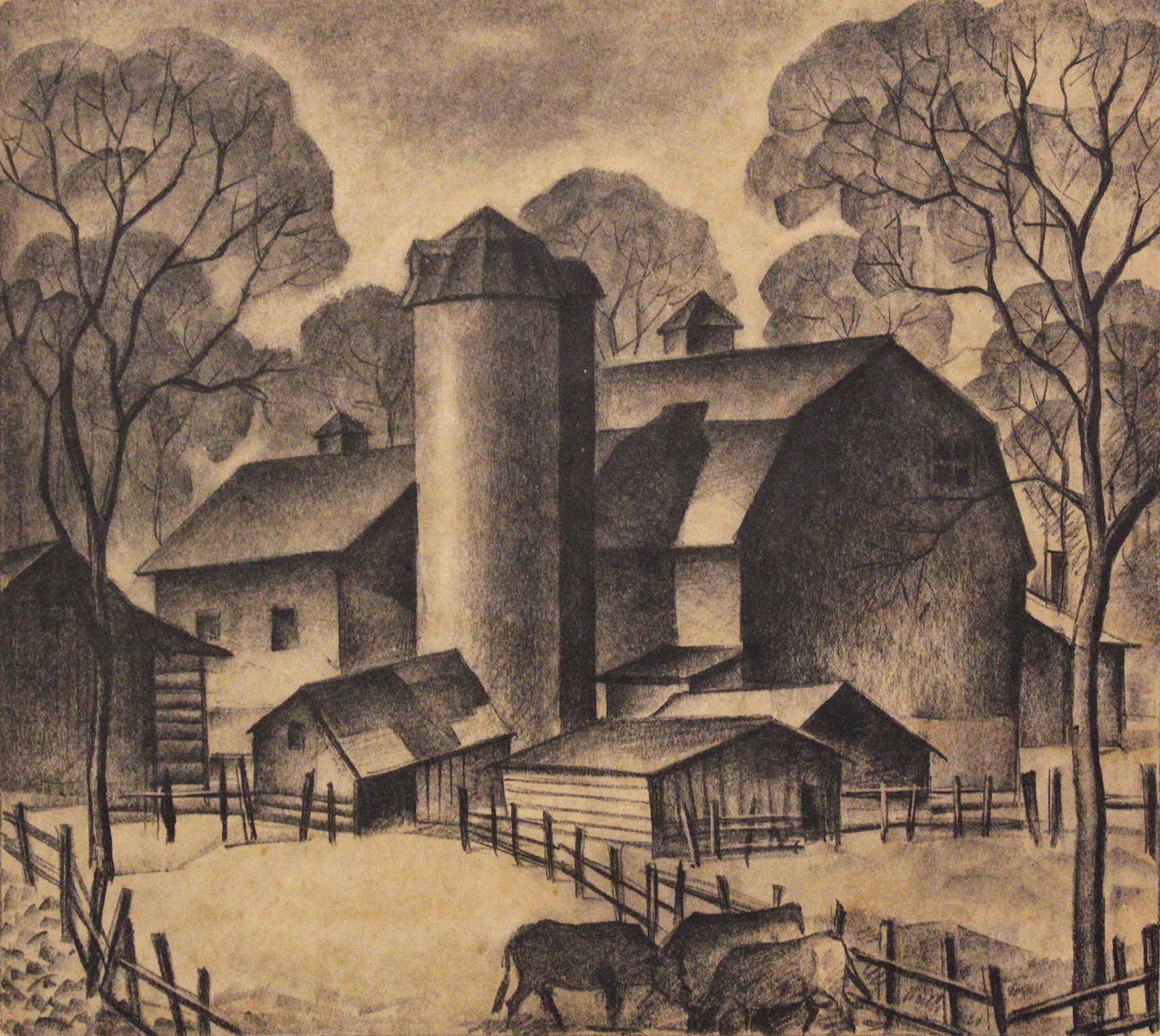
Gregory Orloff (1890-1981), Farm Buildings, 1934. Lithograph on paper, image: 7¼ x 8 in., sheet: 10 x 105/8 in. Gift of Unknown Donor.
The exhibition includes different perspectives and portrayals of agrarian life and experiences, both among artists of the same generation and over time. “Margaret Burroughs, Elizabeth Catlett, Jackson Pollock and Hale Woodruff’s works ran counter to Benton, Curry, and Wood, presenting harsh realities,” explains Yanari-Rizzo. “Although Pollock’s plowing subject aligned with his former Art Students League teacher, Pollock supplanted Benton’s optimistic views with a depiction that is dark and haunting. The long-eared mule looks emaciated, and the land is eerily sparse.” —
Powered by Froala Editor