Five minutes apart, on opposite banks of the Hudson River in New York State, are the homes of two of the country’s greatest landscape artists. Thomas Cole’s substantial, traditional brick home, Cedar Grove, sits among trees on the west bank and Frederic Church’s Persian-inspired mansion, Olana, commands a hill on the east bank. Each in its style demonstrates the difference between the two artists, and their location in the Hudson River Valley denotes their love for the landscape of the northeastern United States.
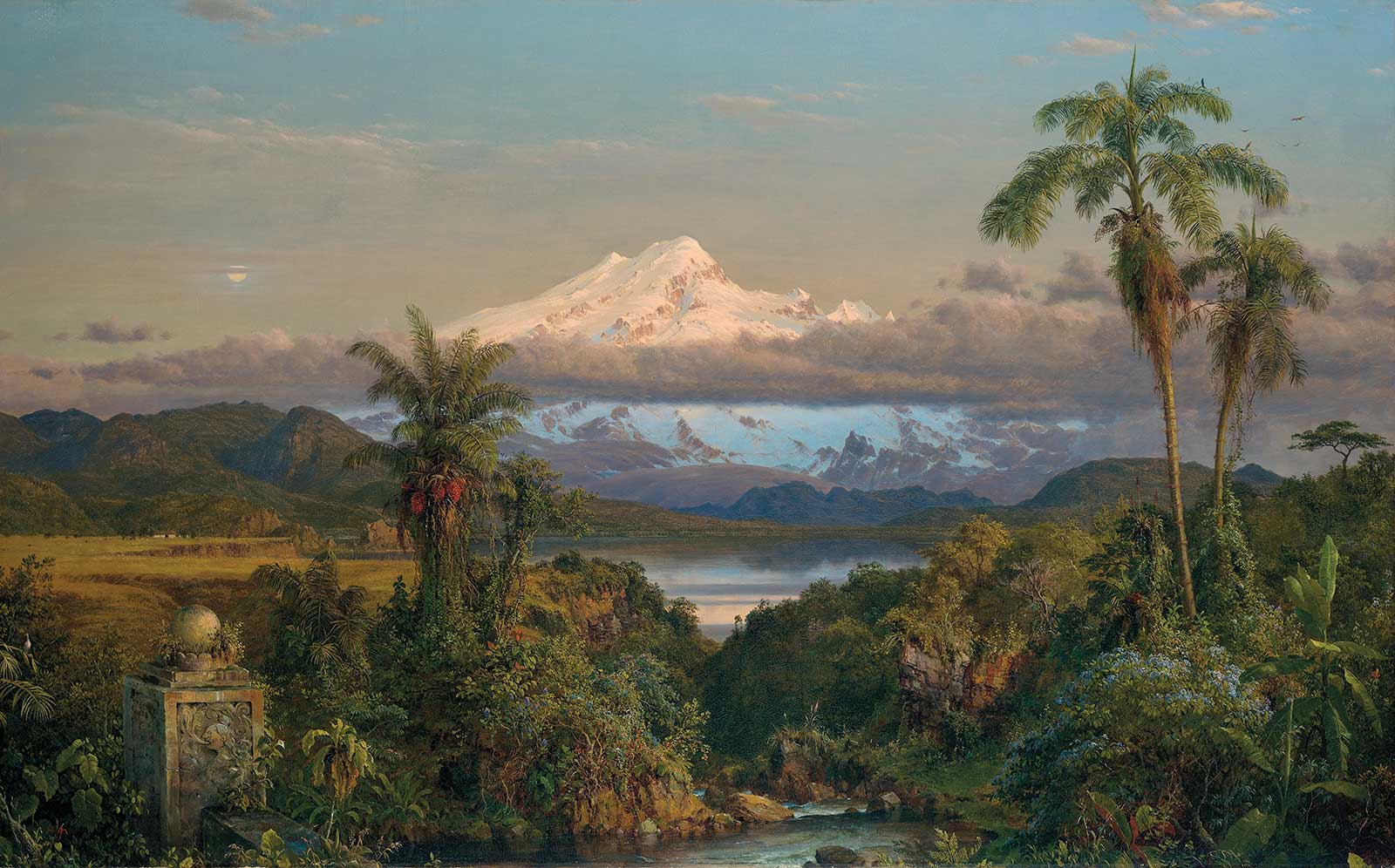
Frederic Edwin Church (1826-1900), Cayambe, 1858. Oil on canvas, 30 x 481/8 in. The Robert L. Stuart Collection, the gift of his widow Mrs. Mary Stuart. The New York Historical, S-91. ©The New York Historical
Cole (1801-1848) was an immigrant from England in 1818. In 1825 he took a trip up the Hudson from New York City and fell in love with the undeveloped landscape of the valley and the Catskill Mountains. He exhibited his paintings in the window of a book and print store in New York where they were recognized for their originality. Cole became known as the founder of the Hudson River School which was neither a school nor restricted to the Hudson River. Artists of the time were striving to form a uniquely American art and focused on its unspoiled landscape for inspiration. Cole wrote to a collector,“I am not a mere leaf-painter,” and painted a monumental series of landscapes, The Voyage of Life, inspired by and celebrating nature as a source of religious and poetic inspiration.
Between 1844 and 1846, beginning at the age of 18, Church (1826-1900) studied landscape painting with Cole at Cedar Grove, the older artist’s only formal pupil. Cole is reported to have said that Church had “the finest eye for drawing in the world.” Church went on to be more than a mere landscape painter. He traveled the world, shaping his outlook and, in effect, brought the world to America.
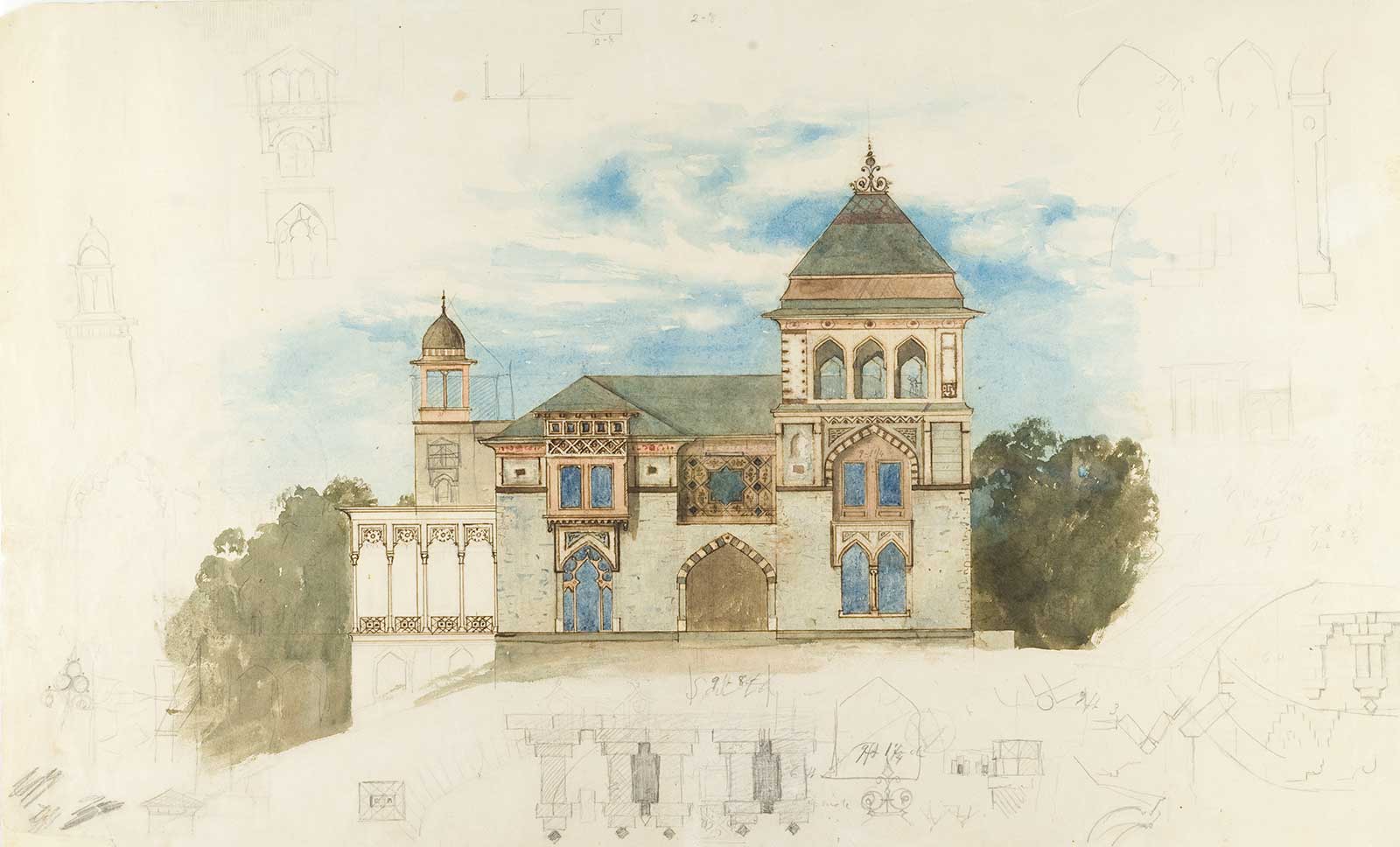
Frederic Edwin Church (1826-1900), Sketch for the Southwest Façade of the Residence at Olana, ca. 1870. Watercolor, ink and graphite on paper, 13 x 2115/16 in. New York State Office of Parks, Recreation and Historic Preservation, Olana State Historic Site, Gift of Olana Preservation, Inc. and Museum Purchase, OL.1980.40(R). © Olana State Historic Site.
Frederic Church: Global Artist is an extensive exhibition opening May 17 at Olana State Historic Site in Hudson, New York. The curators and editors of the accompanying book by the same name are Tim Barringer, Paul Mellon Professor in the History of Art at Yale University; Elizabeth Kornhauser, the Metropolitan Museum of Art and Senior Consulting Curator for the Olana Partnership; and Jennifer Raab, professor of the History of Art at Yale University. The exhibition is the cornerstone of a series of events in “Frederic Church 200,” celebrating the 200th anniversary of the artist’s birth.
The curators write that the exhibition brings together “a number of Church’s finest monumental oil paintings, and exquisite drawings and oil sketches that are indelibly shaped by his life of global travel. Widely exhibited in the United States and Europe during his lifetime, the artist’s paintings won a new level of respect for American art, both in the United States and abroad. Church’s global ambition, embodying the central scientific and political dilemmas of his lifetime, is explored in the exhibition and accompanying book, providing fresh new insights that redefine this artist for contemporary audiences.”
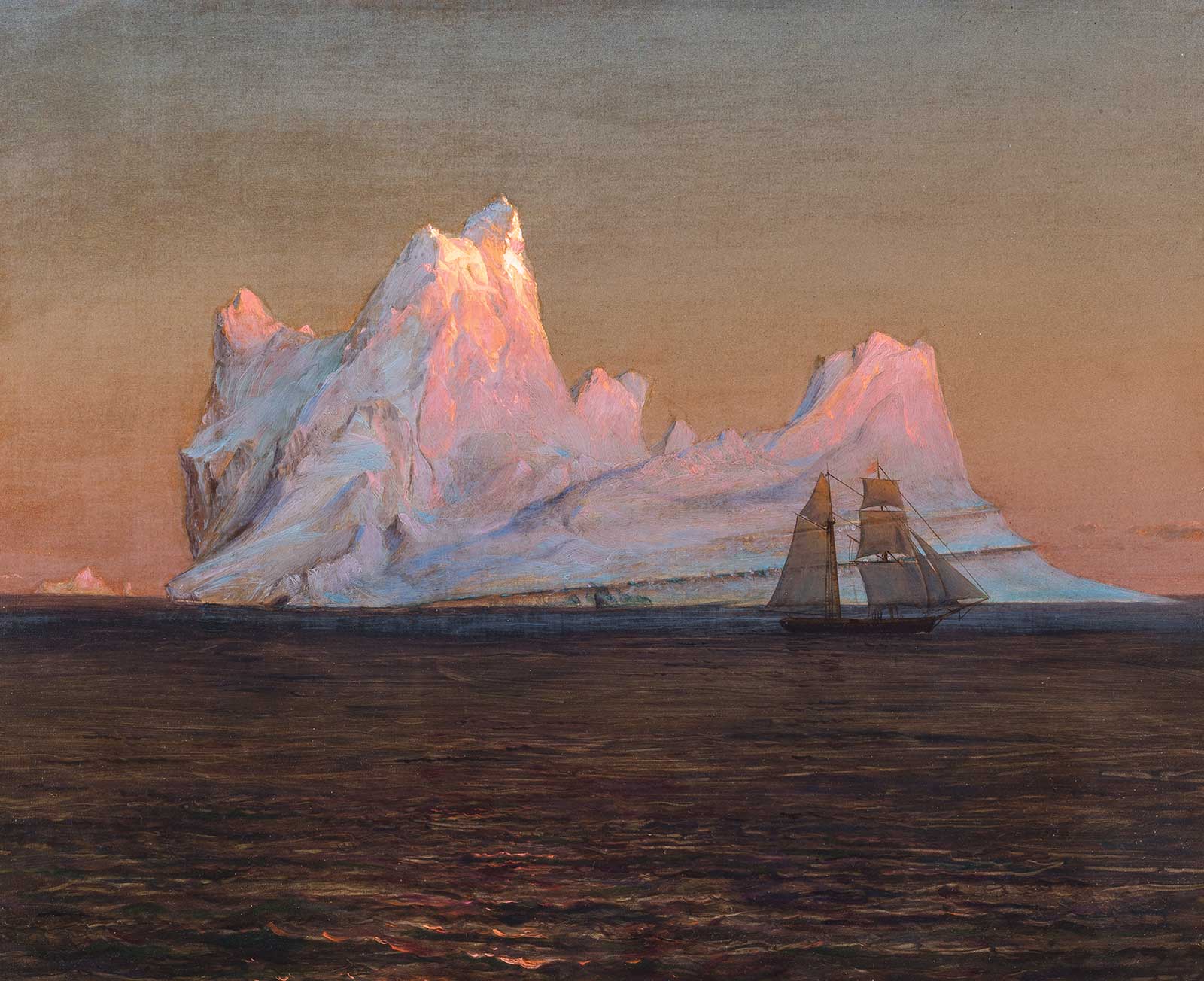
Frederic Edwin Church (1826-1900), The Iceberg, ca. 1875. Oil on canvas, 22 x 27 in. Terra Foundation for American Art, Chicago. Daniel J. Terra Collection, 1993.6 © Terra Foundation for American Art, Chicago.
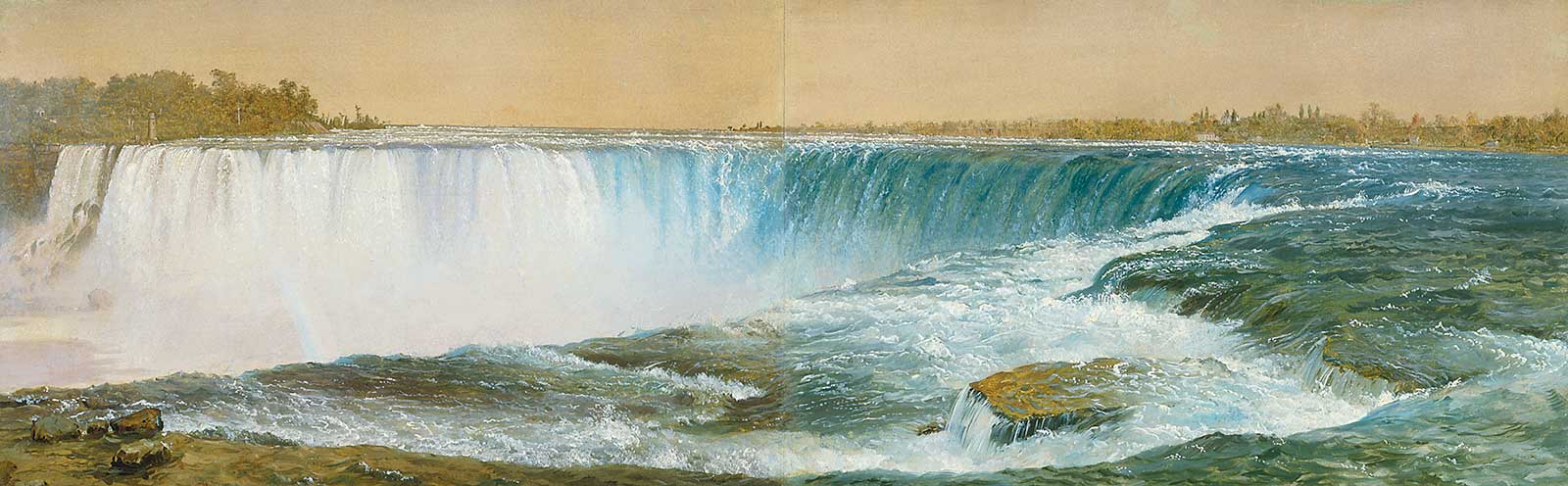
Frederic Edwin Church (1826-1900), Horseshoe Falls, 1857. Oil on two pieces of paper, joined together, mounted on canvas, 11½ x 355/8 in. New York State Office of Parks, Recreation and Historic Preservation, Olana State Historic Site, Gift of Olana Preservation, Inc. and Museum Purchase, OL.1981.15.a © Olana State Historic Site.
Barringer explains, “Frederic Church: Global Artist reveals the extent of Frederic Church’s artistic ambition as a global traveler in the age of empires. It explores his fascination with the natural world, with the hemispheric cultures and histories of the Americas, the Caribbean and the Middle East, and presents Olana as the outcome of his world-wide entanglements.”
The Olana Partnership, the site’s primary programming entity, explains that “Church’s encounters with diverse environments shaped his visual language and ambitions. Works will be drawn from Olana’s own collection as well as major public and private lenders, including the Cooper Hewitt, The New York Historical and the Terra Foundation for American Art.” Olana, itself, is central to the exhibition. Church designed the mansion and its 250-acre landscape with a farm, gardens, lake and forest. Mark Twain called Olana “an exalted hill of art.”
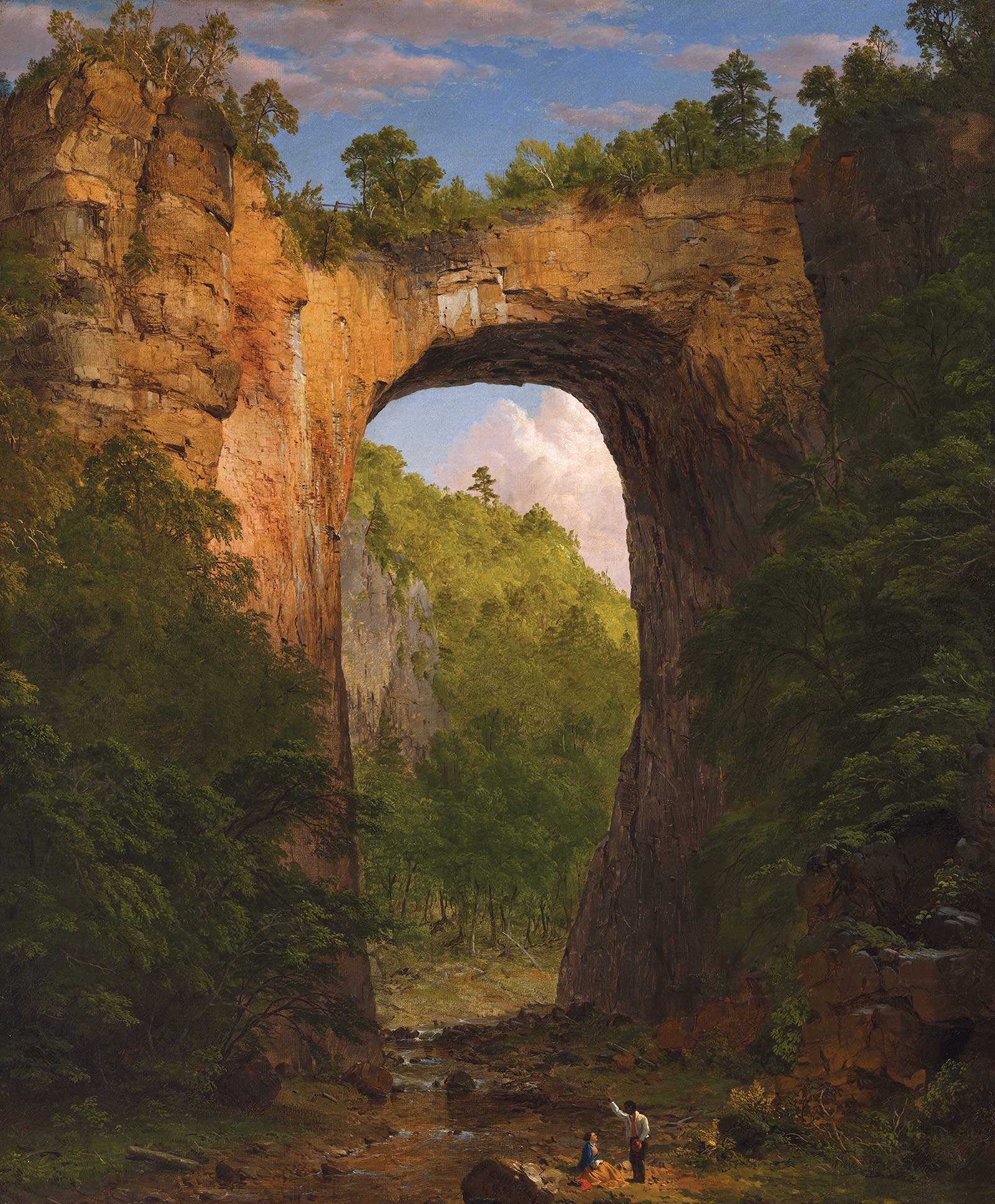
Frederic Edwin Church (1826-1900), The Natural Bridge, Virginia, 1852. Oil on canvas, 38 x 33 in. The Fralin Museum of Art at the University of Virginia, Charlottesville. Gift of Thomas Fortune Ryan, 1912.1. Courtesy of The Fralin Museum of Art at the University of Virginia, Charlottesville. Photography by Mark Gulezian/QuickSilver.
In 1857, Church painted his spectacular oil, Niagara, measuring 40 by 90-and-a-half inches, now in the collection of the National Gallery of Art in Washington, D.C. He produced sketches on site, which were seen by a reporter for The Home Journal, who wrote, “Church passed several weeks at Niagara to great advantage. He has succeeded in making the most comprehensive view of the Falls yet achieved; and we hazard nothing in predicting, that, when transferred to a large canvas and finished, it will be the most satisfactory view of the cataract ever made.” Another commentator, viewing the final work, remarked, “This is Niagara, with the roar left out!”
Church had already made his first trip to South America in the summer of 1853. The curators explain, “Unlike many of his compatriots, including Cole, Church did not go to Europe as a young man. He did not embark on the Grand Tour of European capitals or study in one of the esteemed academies. Instead, in 1853, when he was 27, the painter followed the path of scientists, journeying through Ecuador and Colombia for nearly seven months. He was inspired by the travels of the German naturalist and polymath Alexander von Humboldt (1769-1859), who had spent five years in South America at the turn of the century, writing about his experiences over multiple volumes, which Church kept in his library, and specifically exhorting landscape painters to find inspiration in that continent rather than in more familiar terrain—the Andes rather than the Alps.”
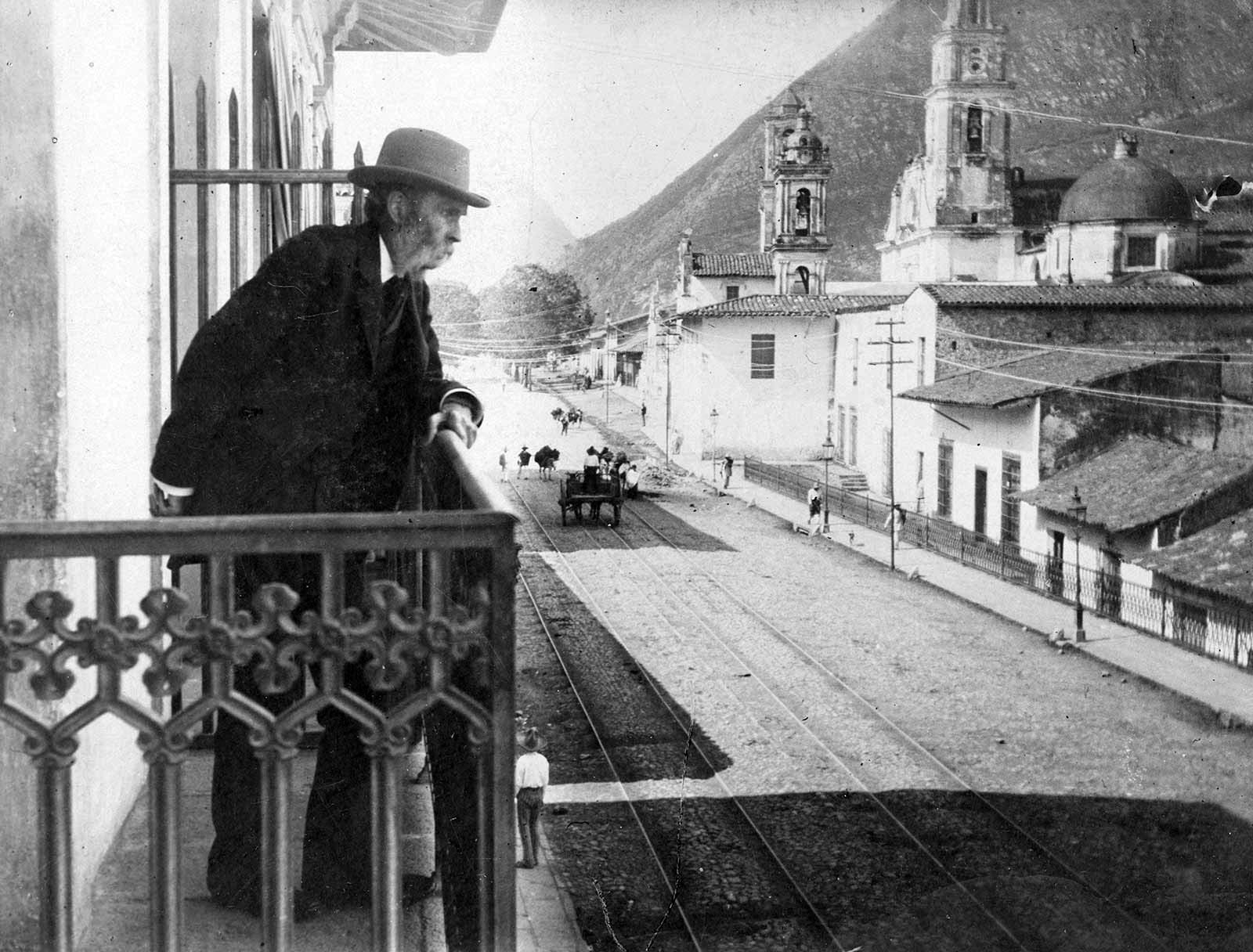
Walter Launt Palmer, Frederic Edwin Church on Wrought Iron Balcony in Orizaba, Mexico, 1895. Emulsion print on paper, 21/8 x 33/8 in. New York State Office of Parks, Recreation and Historic Preservation, Olana State Historic Site, Gift of Olana Preservation, Inc. and Museum Purchase, OL.1992.52.3. © Olana State Historic Site.
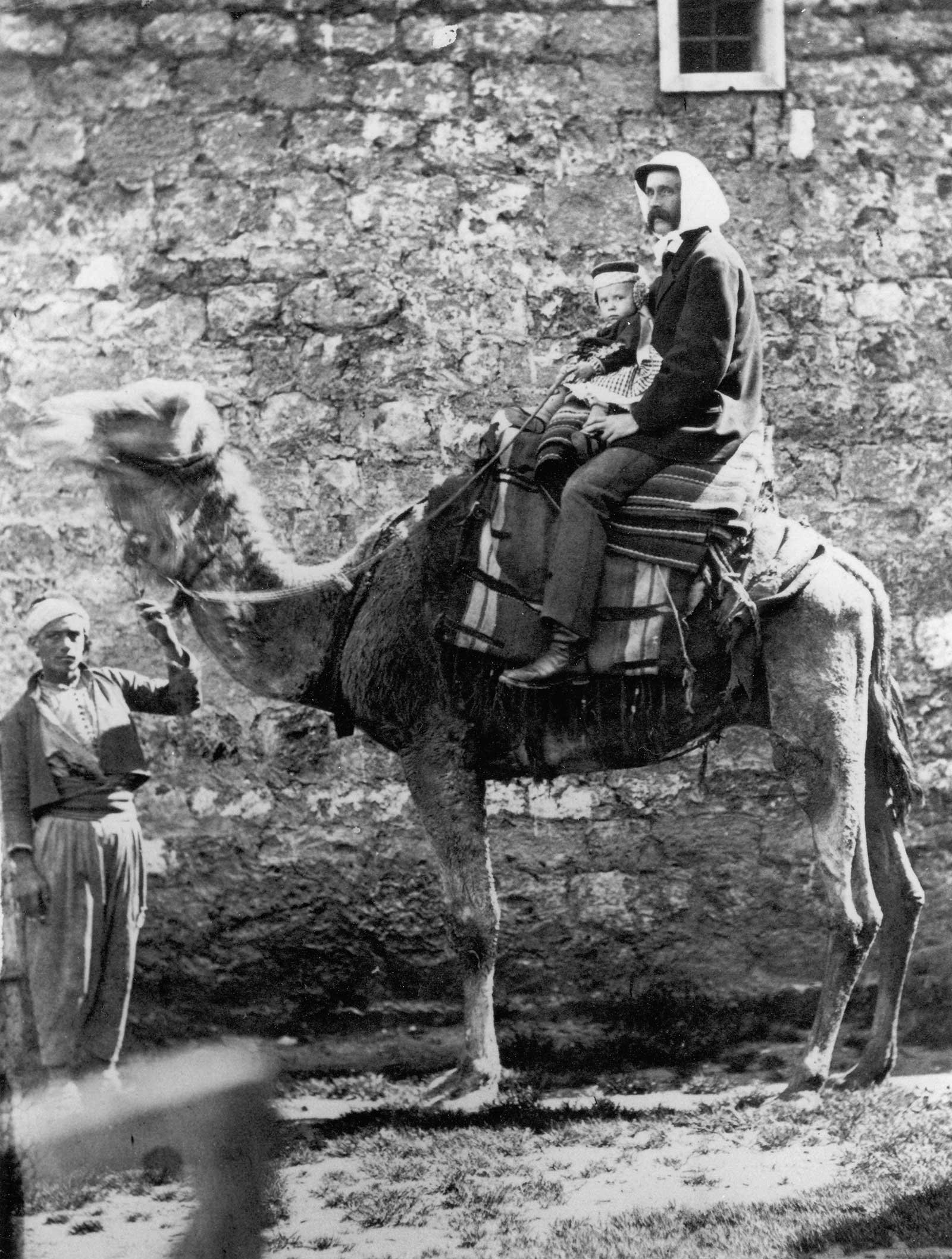
Attributed to Felix Bonfils, Frederic Edwin Church and His Son, Frederic Joseph, on a camel in Beirut, 1868. Carte-de-visite photograph on paper, 47/8 x 33/8 in. New York State Office of Parks, Recreation and Historic Preservation, Olana State Historic Site, Gift of Olana Preservation, Inc. and Museum Purchase, OL.1984.446. © Olana State Historic Site.
In the summer of the year he painted Niagara, he returned to Ecuador and, the following year, produced his painting Cayambe, the volcano von Humboldt considered the most beautiful volcano in South America. Monica Bravo of the Department of Art and Archaeology at Princeton University, comments on its composition: “Cayambe (1858) is a graceful painting yet somewhat daring in composition. Gray stratus clouds sever Cayambe from its peak, whose snow-packed crown glistens white at the composition’s upper center. Following picturesque conventions, it is framed by two taller elements; here, two varieties of high-altitude growing palms, the one on the left heavy with seed. A requisite winding path (a stream flowing into a lake) guides the eye into the middle ground.”
In addition to his travels and painting, Church was active in the community. Among his roles was serving as a founding trustee of the Metropolitan Museum of Art. Writing about Church and the Met, Elizabeth Kornhauser quotes him writing to Martin Johnson Heade in 1870.
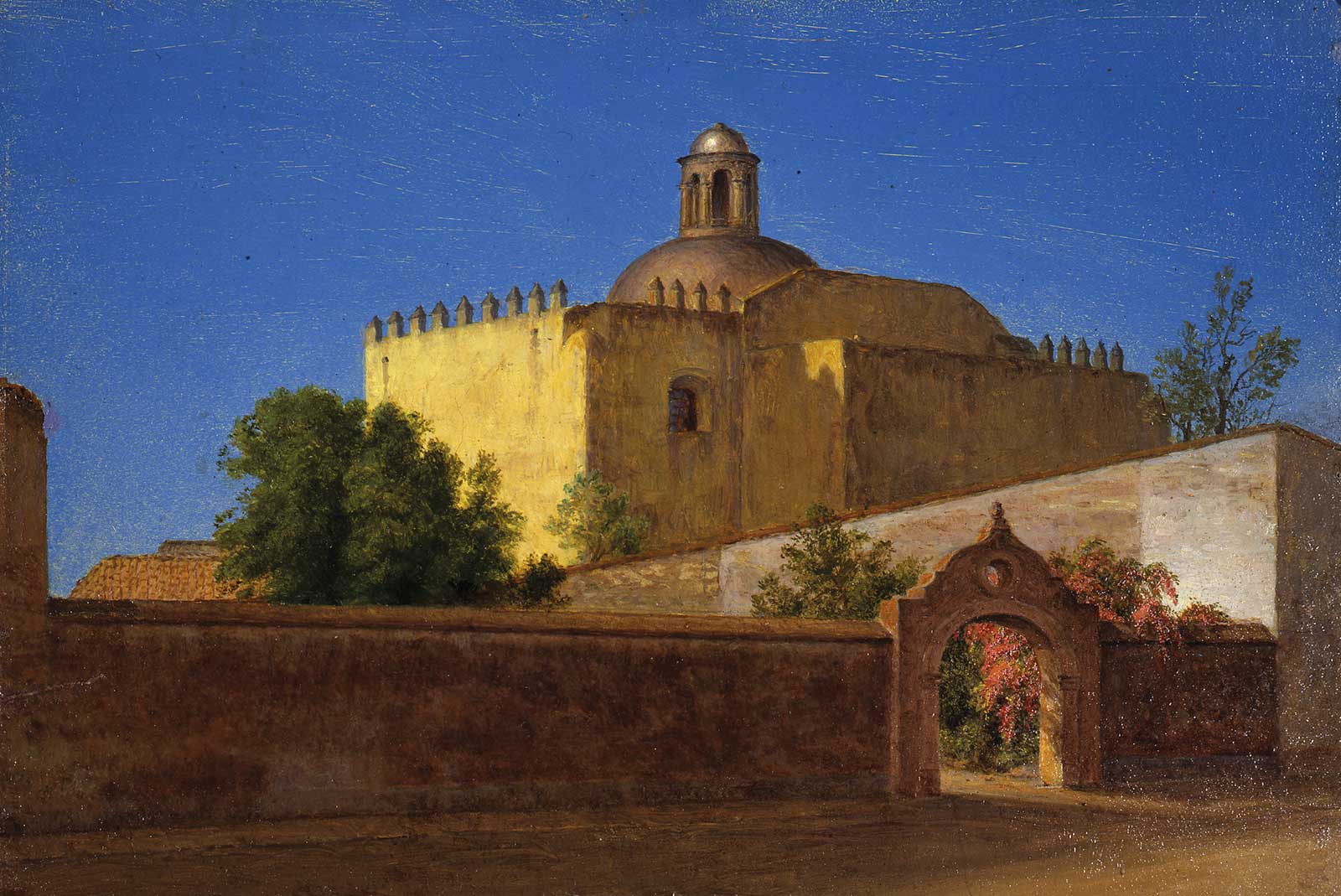
Frederic Edwin Church (1826-1900), Church of San Francisco, Cuernavaca, Mexico, 1898. Oil paint on board, 7¾ x 11½ in. New York State Office of Parks, Recreation and Historic Preservation, Olana State Historic Site, Gift of Olana Preservation, Inc. and Museum Purchase, OL.1977.226.
“There is a great effort in the making to get up a great Art Museum here— I am on four committees relating to it and thus keep my time pretty well filled.” The Met opened later that year.
Sean E. Sawyer, president of the Olana Partnership, comments, “The 2026 bicentennial of Frederic Church’s birth provides a pivotal moment to reexamine the artist’s life and career at a time of momentous change. The fields of American art and landscape studies are moving beyond traditionally held assumptions to consider innovative approaches that inspire broader scholarly and public debate and speak to new generations of audiences. Frederic Church: Global Artist and its accompanying exhibition in Olana’s Sharp Family Gallery establish Church as one of the most compelling and complex landscape painters of the 19th century. His works of art offer a unique opportunity to understand the larger 19th century world and its implications for our own time.” —
May 17-October 25, 2026
Frederic Church: Global Artist
Olana State Historic Site
5720 NY-9G, Hudson, NY 12534
t: (518) 751-0344, www.olana.org
Powered by Froala Editor
Powered by Froala Editor